
| In Media ResThe Official Newsletter for the Media Ecology AssociationJuly 2026 |
 |
| Editor’s Notes This issue of In Medias Res reflects both the strength of the Media Ecology Association’s community and the continued growth of the field. We look back on the 2026 Annual Convention with gratitude, especially for the extraordinary work of Jacqueline McLeod Rogers in creating such a memorable gathering. We also celebrate the recipients of the 2026 MEA Awards and the wide range of scholarship, creative work, teaching, service, and public engagement they represent. At the same time, this issue looks ahead. The call for proposals is now open for the 2027 convention in Huelva, Spain, nominations are being accepted for several positions on the MEA Executive Board, and the Institute of General Semantics and Universidad Panamericana have announced plans for a new hybrid PhD in Media Ecology expected to launch in 2027. Together, these developments remind us that media ecology continues to grow through scholarship, leadership, collaboration, and the ongoing work of building intellectual communities. —Tiffany A. Petricini Editor, In Medias Res |
| From the Association Congratulations to Jacqueline McLeod Rogers The Media Ecology Association extends its sincere congratulations and gratitude to Jacqueline McLeod Rogers for her outstanding organization of the 2026 Annual Convention. The speakers, venues, banquet location, coffee breaks, meals, and countless logistical details were all exceptional. The result was a welcoming, intellectually rich, and truly memorable gathering for the MEA community. Organizing a convention of this scale requires months of careful and often invisible work. Jacqueline’s leadership created the conditions for meaningful conversation, renewed friendships, new collaborations, and the exchange of ideas that sustains the field of media ecology. Thank you, Jacqueline, for your remarkable work, dedication, and care. 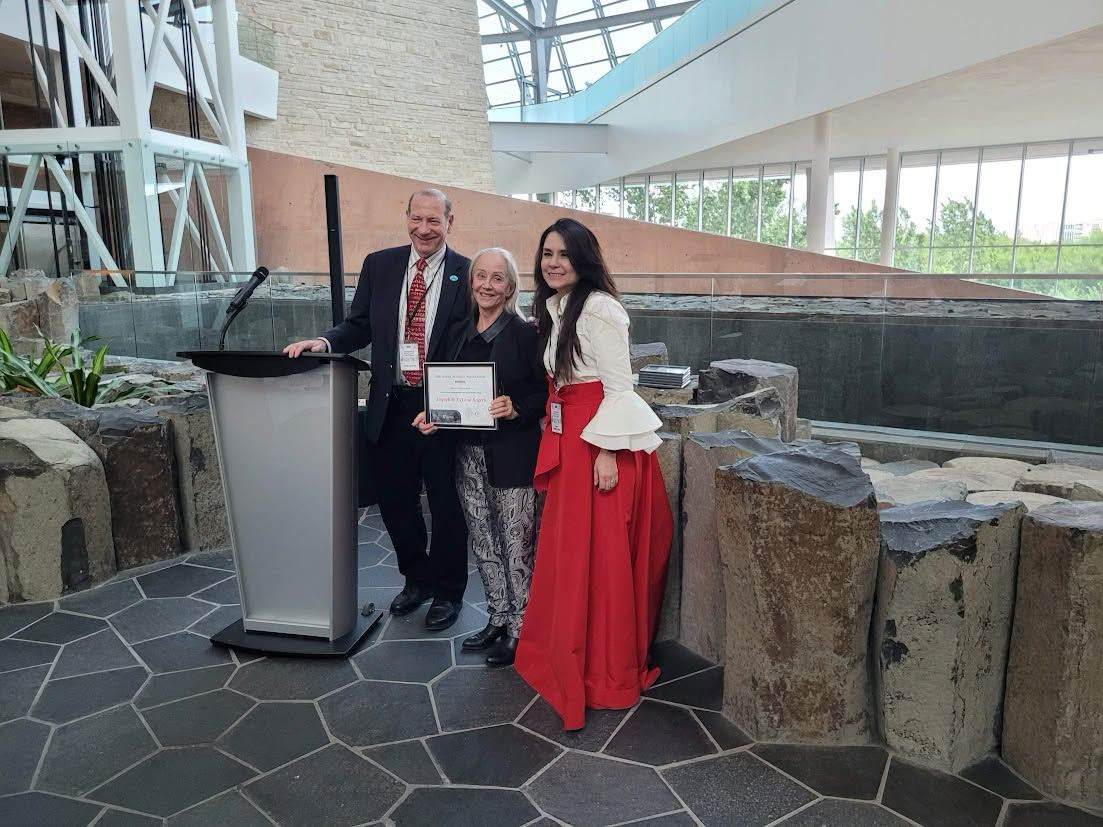 From left to right stand Lance Strate, Jacqueline McLeod Rogers, and Laura Trujillo-Linan as Jacqueline is honored with an award. Photo by Andrey Mir.  From left to right, standing is Lance Strate, followed by Laura Trujillo-Linan, Peggy Cassidy, Thom Gencarelli, Susan Drucker and Corey Anton. Photo by Christine Knopf.  Speaker Derrick de Kerckhove addresses the audience during the Postman Lecture. Photo by Christine Knopf.  Wendy Hui Kyong Chun gives the Ong Lecture. Photo by Christine Knopf. 2026 MEA Awards  Selected book and film covers from works honored in the 2026 Media Ecology Association Awards The Media Ecology Association congratulates the recipients of the 2026 MEA Awards, presented during the Annual Convention. These awards recognize outstanding scholarship, teaching, creative work, service, activism, journalism, editing, and public intellectual activity in the field of media ecology. Scholarship and creative work Marshall McLuhan Award for Outstanding Book in the Field of Media Ecology Tom Cooper, Wisdom Weavers: The Lives and Thought of Harold Innis and Marshall McLuhan Walter Benjamin Award for Outstanding Article in the Field of Media Ecology Sasha Crawford-Holland, “A Sense of Security: The Visual Politics of COVID-19 Thermography” Erving Goffman Award for Outstanding Scholarship in the Ecology of Social Interaction Celia Pearce, Playframes: How Do We Know We Are Playing Susanne K. Langer Award for Outstanding Scholarship in the Ecology of Symbolic Form Susanna Berger, The Deformation: Attention and Discernment in Catholic Reformation Art and Architecture Ross A. Eaman, Architecture as Communication: A Medium Like No Other Dorothy Lee Award for Outstanding Scholarship in the Ecology of Culture David Wittenberg, Big Culture: Toward an Aesthetics of Magnitude Lewis Mumford Award for Outstanding Scholarship in the Ecology of Technics Seth Long, The Last Mixtape: Physical Media and Nostalgic Cycles Harold A. Innis Award for Outstanding Thesis or Dissertation in the Field of Media Ecology Mora Matassi, “Digital Tango: Processes and Implications of Turning Towards and Away from Social Media” Mary Shelley Award for Outstanding Fictional Work Chris Campanioni, VHS John Culkin Award for Outstanding Praxis in the Field of Media Ecology Fred Peabody and Peter Raymont, Digital Tsunami Teaching, service, and public engagement Louis Forsdale Award for Outstanding Educator in the Field of Media Ecology Corey Anton Jacques Ellul Award for Outstanding Media Ecology Activism Wab Kinew James W. Carey Award for Outstanding Media Ecology Journalism James Marriott Christine L. Nystrom Award for Career Achievement in Service to the Field of Media Ecology Heather M. Stassen Edmund S. Carpenter Award for Career Achievement in Editing in the Field of Media Ecology Jacqueline McLeod Rogers Walter J. Ong Award for Career Achievement in Scholarship Wendy Hui Kyong Chun Neil Postman Award for Career Achievement in Public Intellectual Activity Derrick de Kerckhove Convention paper awards MEA Convention Top Paper Award Adam Yee, “‘What Has the Most Relevance to Students Is That Which the Information Environment Least Provides Them’: Applying Neil Postman’s Thought to Music Education” Linda Elson Scholar Award for the Top Student Paper at the MEA Convention Alejandra Ortega Legaspi, “Antiheroes as Moral Interfaces: Youth, Transmedia Worlds, and the Ethical Dynamics of Contemporary Media Ecologies” MEA Executive Board Nominations The Media Ecology Association is accepting nominations and self-nominations for four elected positions on the Executive Board.Prior board experience is not required. Nominees must be MEA members in good standing. Open positions Vice President Elect — one-year initial term within a four-year leadership sequence The Vice President Elect progresses to Vice President, President, and Immediate Past President over four years. Responsibilities include supporting the annual convention, working with convention hosts, representing the MEA in relationships with other professional organizations, and helping provide continuity in the Association’s leadership. Recording Secretary — one-year term The Recording Secretary records, collects, and distributes discussions, activities, and reports from MEA Board meetings while participating in the broader work of the Board. Newsletter Editor — one-year termThe Newsletter Editor compiles, edits, and distributes In Medias Res and participates in the broader responsibilities of the Executive Board. Member-at-Large — three-year term Members-at-Large promote Association activities, assist with legal and fiduciary matters, review programs and policies, and support leadership recruitment and succession planning. Nomination details Nominations are due September 15, 2026. Nominees will be asked to submit a brief statement of approximately 100–150 words introducing themselves and explaining their interest in serving the MEA. Voting will take place online in October 2026. Those elected will begin their terms in January 2027 and should plan to attend the Executive Board meeting in New York City. The MEA will reimburse board members for travel expenses. Send nominations or self-nominations to Immediate Past President Heather Stassen at:hstassen@daemen.edu Annual Convention Updates Save the Date: 2027 MEA Convention in Huelva, Spain 28th Annual Media Ecology Association Convention Understanding Media in Today’s World June 22–26, 2027 University of Huelva, Huelva, Spain The Media Ecology Association invites paper and session proposals for its 28th Annual Convention.The 2027 theme, “Understanding Media in Today’s World,” explores how media environments reshape perception, social organization, cognition, education, public discourse, and human agency in an AI-driven and digitally connected world. The convention seeks to move beyond narrowly technical approaches to media literacy and toward a deeper ecological understanding of media as environments that structure thought, culture, and social life.Submissions may address the convention theme or any topic relevant to media ecology. Proposals concerning artificial intelligence, platform culture, automation, symbolic environments, digital orality, media education, technological change, and emerging forms of mediation are especially welcome. Submission requirements Proposals may be submitted in English or Spanish and should include: A title An abstract of no more than 250 words Author name or names Contact information Authors may submit no more than two proposals. Important dates December 1, 2026 Paper and session proposals due February 15, 2027 Full manuscripts due for Top Paper and Linda Elson Top Student Paper award consideration March 19, 2027 Student travel grant applications and early registration due June 22–26, 2027 Convention dates Send proposals to:mediaecologyspain@gmail.com Convention organizer: Octavio Islas Contact: joseoctavio.islas@gmail.com Hosted by the Red Internacional Alfamed, the convention will include four days of scholarly exchange in Huelva, followed by a special cultural and tourist experience in Seville. MEA in the Field New Hybrid PhD in Media Ecology  The Institute of General Semantics, in partnership with Universidad Panamericana, is preparing a new hybrid PhD in Media Ecology, expected to open in 2027. The program is presented as the first doctoral program in Media Ecology in Latin America. It will offer an interdisciplinary approach to understanding the effects of media, technology, communication, and information on individuals, organizations, and society. The program brings together four areas:Information ecology: information systems, cybernetics, and complexity, Communication ecology: communication environments, relationships, and cultureSemantic ecology: language, meaning, symbols, and cultural codesEcology of technics: technology, innovation, and their impact on society and individuals According to the program announcement, the PhD is intended to prepare researchers and scholars to analyze, anticipate, and respond to the challenges of a rapidly changing world. Additional information about the program launch, curriculum, faculty, scholarships, information sessions, and admissions process will be shared as it becomes available.Join the PhD priority list |
| More Ways to Get Involved with MEA MEA Book Club The MEA hosts a monthly reading group on language, technology, and the human condition via Zoom. Anchored in the tradition of media ecology, the group is open to seasoned scholars and curious newcomers alike, including both MEA members and nonmembers. Acquiring and reading the book is strongly encouraged but not required. Curiosity and thoughtful dialogue are always welcome. Upcoming Meetings (8–9 PM Eastern Time): June 1, 2026 – Walter Ong, Orality and Literacy July 6, 2026 – Walter Ong, An Ong Reader, (Thomas J. Farrell and Paul A. Soukup, eds.) Attendance is free, but Zoom registration is required to receive the meeting link. Visit the MEA Book Club webpage. Virtual Coffee Meetings Do you have questions about media ecology, need advice on a study, or want to invite an expert to speak in your class? Schedule a virtual coffee meeting with an MEA scholar! To arrange a meeting, visit our website If you’re an experienced media ecologist interested in volunteering for these meetings, we’d love to hear from you! Book Reviewers Wanted Have you read a great book related to media ecology? Consider writing a review for Explorations in Media Ecology! For more details and a format template, contact jbogaczyk@gmail.com. Join the Listserv Stay connected with the MEA community by joining the discussion group. The discussion group is open to all for sharing views, exchanging information, and learning about events related to media ecology. Follow MEA on Social Media Connect with us on social media to stay updated on news, events, and discussions. Follow us on Facebook and X to join the conversation! |

 Blog de Octavio Islas